
I had answered their questions. I just hadn't realised they were about a different visit entirely.
I had built the restaurant from nothing. When Border Force came in, I answered every question they put to me — or I thought I did. What I didn't realise was that the letters I was responding to weren't about the original inspection at all. They were about a second raid, on a different operator, on the same premises. I had been answering the wrong questions. And now I was being told I couldn't be a director for ten years.
The original problem dated back years. Border Force had visited the restaurant and found workers who didn't have the right to work in the UK. A civil penalty was imposed on the business. We appealed it — but unfortunately I couldn't attend the hearing — and in the end we didn't pay. Time passed, the company went into liquidation, and I assumed that was the end of it.
It wasn't. The premises were taken over by a new operator, and Border Force came back — a second visit, a second inspection, another fine. But the letters that followed were addressed to me and looked like the original matter resurfacing. I completed the information requests thinking I was dealing with the first penalty. I wasn't. I was inadvertently providing wrong information about a separate incident entirely.
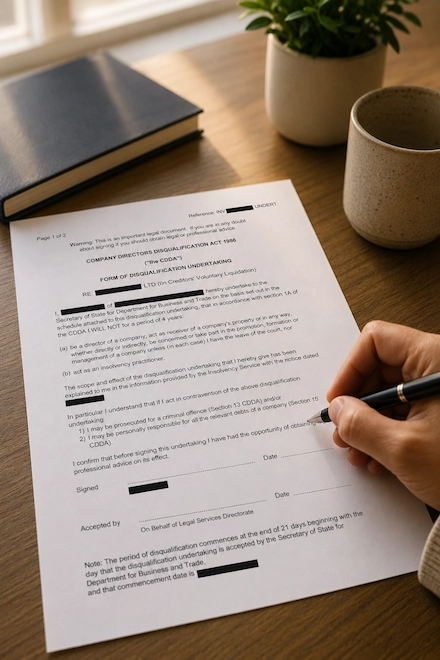
The Insolvency Service concluded that this amounted to misconduct — and they could see two penalties. The proposed sanction was a director's disqualification — a voluntary undertaking — for ten years. That would mean a decade in which I could not be a director of any company in the UK. My ability to work, to run a business, to do the only thing I had ever done professionally, was on the line.
The Outcome in brief
Advised by Priti Shah, Lightside Financial · Referred by Tidy Money – Chartered Accountants · Worked with MD Law
Mr. S had believed that the liquidation of his company would draw a line under the matter. When the disqualification notice arrived, the ground shifted. He came to Lightside facing a decade in which he could not run a business — the only professional life he had known. When the Insolvency Service confirmed the reduction to four years and confirmed no civil penalty would be imposed, the relief was significant. Not just the financial exposure avoided, but the knowledge that the record would reflect what had actually happened.
Facing a director's disqualification or personal liability concern?
The Insolvency Service's first position is not always the final one. Get in touch — there is no charge for an initial conversation.
The work behind the outcome
We secured a reduction in Mr. S's voluntary undertaking from ten years to four years, and achieved the complete removal of a civil penalty that could have reached £60,000. The Insolvency Service accepted our account of the events in full: that the incorrect information provided was the result of honest confusion between two separate Border Force raids, not deliberate misconduct.
When Mr. S came to us, the proposed ten-year undertaking felt immovable. Our first task was to understand precisely what had happened. That meant working through the full chronology of both Border Force visits, the two sets of civil penalties, and the sequence of information requests and responses that had created the misconduct finding.
What emerged was clear: there had been two entirely separate enforcement actions. The first, against Mr. S's company, had been appealed and then allowed to lapse when the company went into liquidation. The second was directed at a different operator on the same premises. The letters that followed — addressed and formatted in a way that invited confusion — had been answered by Mr. S in the genuine belief that he was responding to the original matter. He hadn't intended to mislead anyone. He simply hadn't understood what he was being asked.
We compiled a comprehensive brief setting out this account with supporting evidence, and passed it to solicitors MD Law to frame the formal appeal. The framing was critical — the appeal had to be precise enough to correct the misconduct finding without opening new avenues of concern. It was submitted to the Insolvency Service's solicitors, who reviewed it and referred the matter back to the Insolvency Service directly.
The Insolvency Service accepted our representations. The voluntary undertaking was reduced from ten years to four — reflecting the original fine, not the compounded position — and the civil penalty that could have been imposed for the first visit was dropped entirely. We secured a reduction in Mr. S's voluntary undertaking from ten years to four years, and achieved the complete removal of a civil penalty that could have reached £60,000.